
Inflation data, trading activity of foreign investors and global trends would dictate sentiment in the stock market this week, according to analysts.

Strong domestic growth will continue to draw foreign investment into the Indian economy, Reserve Bank of India (RBI) Governor Sanjay Malhotra said on Tuesday. He said this was reflected in recent free trade agreements and investment commitments by large technology companies.

For the time being, the RBI is done with the cuts. A cut in October, which many are still predicting, is not certain. Of course, if growth nosedives, the script will be different, expects Tamal Bandyopadhyay.
The RBI's monetary policy committee is expected cut benchmark interest rate by 25 basis points in its policy review meeting next month to push growth, India Ratings and Research (Ind-Ra) said on Thursday. "We expect the headline inflation in FY25 to cool off to 4.7 per cent. Monetary easing may be limited to 75 bps in FY26," Ind-Ra Chief Economist and Head Public Finance, Devendra Kumar Pant said.

Business confidence in India Inc rose to a five-quarter high in December quarter of FY26, amid further reform expectations and steady domestic demand, a survey by industry body Confederation of Indian Industry (CII) showed. The CII Business Confidence Index (BCI) rose for the third consecutive quarter to 66.5 in the December quarter from 66 in the preceding September quarter.

In an event-heavy week ahead, stock markets are expected to track Q3 corporate earnings from several blue-chip firms, including TCS and Infosys, while inflation data and global trends would also dictate investors' sentiment, analysts said.

India emerged reasonably well from 2025. But now, the oil shock and war-related supply disruptions have again driven funds out of India and significantly weakened the rupee, points out Ajay Chhibber.

WPI inflation data, trading activity of foreign investors and global cues would dictate trends in the stock market this week, analysts said.

Since February 2025, the RBI has reduced the policy rate by 100 basis points. In its previous policy review in April, it had also trimmed the repo rate by 25 basis points to 6 per cent.
The core dilemma remains: Why provide further stimulus to an economy that is already booming at an 8 per cent growth rate? asks Rajeswari Sengupta.

The Indian rupee weakened against the US dollar due to rising crude oil prices, geopolitical tensions in the Middle East, and foreign fund outflows.

If Chinese growth starts falling, sharply or otherwise, the risk on trade might reverse.

Persisting uncertainties related to the US trade policies pose downside risk to the overall demand in the Indian economy while the inflation outlook for the near term has become more benign than anticipated earlier, RBI said in its latest bulletin on Thursday. In the August bulletin, the Reserve Bank of India (RBI) also said that India's sovereign rating upgrade by S&P bodes well for capital inflows and sovereign yields, going forward.

Fitch Ratings on Thursday raised India's GDP growth forecast for the current fiscal to 7.4 per cent, from 6.9 per cent, on increased consumer spending and improved sentiment boosted by GST reforms.

Gold prices are likely to remain in a consolidation phase in the near term, but the overall bias will continue to stay positive amid heightened expectations of a US Federal Reserve rate cut in its September policy meeting, analysts said. Traders will closely track US macroeconomic data, such as Q2 GDP, PCE inflation, and speeches from Fed officials, which will provide more insights into the monetary policy stance of the Federal Reserve and the trajectory of the bullion sentiment, they added.

The Reserve Bank of India on Friday proposed to allow banks to lend to Real Estate Investment Trusts (REITs) with certain prudential safeguards to deepen the financing pool for the real estate sector.

Banks are witnessing a surge in hiring for sales staff in secured segments such as home, vehicle and gold loans as compared to the recovery category, driven by a boost in business growth, and a host of regulatory measures aimed at improving ease of doing business, according to industry experts.

The Confederation of Indian Industry (CII) has proposed a 20-point policy agenda to the finance ministry, including a conflict-linked emergency credit line guarantee scheme and tax rationalisation on energy inputs, to support MSMEs, exporters, and energy-intensive industries affected by the ongoing West Asia war.

Among the Sensex constituents, Bharat Electronics Ltd, Eternal, Trent, Tata Steel, Bajaj Finance, Adani Ports, Bajaj Finserv, State Bank of India, PowerGrid, Asian Paints, Tata Motors Passenger Vehicles, Titan, NTPC, Kotak Mahindra Bank, Larsen & Toubro and Bharti Airtel were among the laggards. Tech Mahindra, HCL Technologies, Reliance Industries and HDFC Bank were the only gainers.

Almost a decade after India shifted to a formal inflation-targeting regime under the Monetary Policy Committee (MPC) framework of the Reserve Bank of India (RBI), a high-level panel of economists said that the flexible inflation targeting has largely worked in keeping it under control and no major revamp is required.

India's main inflation measure, the Consumer Price Index (CPI), is set for another major update, even though it has been in its current form for only about 15 years.

Only bona fide victims would be compensated by banks within five days of receiving the complaint.

Notwithstanding global headwinds, the Indian economy saw further momentum in October on the back of goods and services tax (GST) rate rationalisation and festival spending, as indicated by high-frequency indicators, the Reserve Bank of India's (RBI's) monthly State of the Economy report said.

Analysts predict continued volatility in Indian equity markets due to domestic macroeconomic data, F&O expiry, global developments including US tariff policies, and geopolitical tensions.

Reserve Bank of India (RBI) Governor Sanjay Malhotra, with Deputy Governors Poonam Gupta, Swaminathan J, T Rabi Sankar, and M Rajeshwar Rao, responded to a range of queries in the post-policy interaction with the media

The transmission of the February and April rate cuts is now complete, validating the central bank's monetary stance and contributing to a revival in credit growth, said Reserve Bank of India (RBI) Governor Sanjay Malhotra on Friday. "We now have preliminary figures for June credit rates, and we find that for new loans, the rates are lower by at least 50 basis points (bps)... within two months of our 50-bp cut, we are in June, and the whole of the monetary policy transmission has happened.

Among the Sensex constituents, Asian Paints, Tech Mahindra, HCL Technologies, Tata Steel, Maruti Suzuki India, Sun Pharmaceuticals, Tata Consultancy Services, ICICI Bank, Bajaj Finance, UltraTech Cement, Mahindra & Mahindra and Tata Motors Passenger Vehicles were the laggards. However, Eternal, Titan, Adani Ports, Bharat Electronics Ltd, State Bank of India, Bajaj Finserv, NTPC and Bharti Airtel were among the gainers.

Global risks include a potential delay in the US-India trade agreement, the possibility of a sharp correction in US equity markets, and renewed geopolitical tensions.
Deloitte India on Thursday projected India's economy to grow 6.7-6.9 per cent in the current fiscal amid buoyant demand and policy reforms. Indian economy grew 7.8 per cent in the April-June quarter of current fiscal.

The country's primary capital markets delivered a robust performance in FY26, emerging as a global leader in initial public offerings (IPOs) despite an uncertain environment, the Economic Survey said on Thursday.

Activity in the corporate bond market is set to gain momentum following a 25-bp policy repo rate cut by the rate-setting panel of the Reserve Bank of India (RBI). State-owned public cebPower Finance Corporation (PFC) and Small Industries Development Bank of India (Sidbi) are planning to raise up to Rs 11,500 crore through bonds on Tuesday as issuers expect borrowing costs to ease.

Equity markets fell on Monday, with benchmark indices recording their worst session in over two months amid caution ahead of the US Federal Reserve's (Fed's) policy announcement and renewed uncertainty over the US-India trade deal. Sustained selling by foreign portfolio investors (FPIs) also weighed on sentiment.
Uncertainties over the impact of the United States' (US') tariffs on India, along with the ongoing transmission of past rate cuts, prompted the members of the Reserve Bank of India's Monetary Policy Committee (MPC) to maintain the status quo during the August meeting, the minutes showed. While some of the external members highlighted their concern over growth, the internal members cited the one-year headline inflation rate overshooting the 4 per cent target.

The US Fed's interest rate decision will be the major factor dictating trends in the domestic equity market this week, with global movements and foreign investor activity also influencing sentiment, according to analysts. Stock markets ended the last week on a subdued note, with benchmark indices Sensex and Nifty closing flat.

Wholesale price inflation (WPI) fell to (-) 1 .21 per cent in October, driven by a decline in prices of food articles like pulses and vegetables, as well as lower fuel and manufactured items' prices, government data showed on Friday.
The Reserve Bank of India (RBI) on Friday delivered a 25 basis point (bps) repo rate cut analysts expected, driven by the strong 8.2 per cent GDP growth in the September quarter. However, analysts do not expect a runaway market rally as the impact of US tariffs continues.
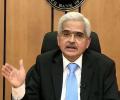
Reserve Bank Governor Shaktikanta Das on Tuesday said the fiscal-monetary coordination was at its best during the last six years even as he thanked Prime Minister Narendra Modi for giving the opportunity to head the monetary authority of the country. Das, in a series of posts on X, on his last day of his six-year term as RBI Governor, also thanked the Finance Minister, various stakeholders and his colleagues at the central bank.

From the Sensex firms, State Bank of India, Bajaj Finserv, Bajaj Finance, Maruti, HCL Tech, Larsen & Toubro, Mahindra & Mahindra and Infosys were among the major winners. However, Hindustan Unilever, Eternal, Tata Motors Passenger Vehicles, and Sun Pharma were among the laggards.

'I will not be surprised if there is a 7 per cent handle in front of the decimal place for the full financial year.'

Reserve Bank Governor Sanjay Malhotra on Wednesday said there is no proposal to levy any charge on UPI transactions.
